

- Your cart is empty
- Continue shopping
-
admin
- Posted on
- Categories:Kitchen Equipment Guide
Quick Answer
Choosing the right commercial ice machine depends on how much ice your business uses daily, the number of customers you serve, and your busiest operating hours. Restaurants, cafés, hotels, and catering businesses have different ice requirements. A machine with insufficient capacity can delay service, while an oversized machine may increase equipment costs and occupy unnecessary space. Calculate your peak daily ice consumption, allow an additional 10–20% for demand changes, and check the machine’s actual production capacity under UAE operating conditions.
Key Facts
- Daily Ice Production: Commercial ice machines are rated by how many kilograms of ice they can produce in 24 hours.
- Restaurant Requirements: Full-service restaurants can use approximately 0.7–0.9 kg of ice per customer daily, depending on the menu and beverage service.
- Storage Capacity: Ice production and ice storage are different. Your storage bin must hold enough ice for busy service periods.
- UAE Climate: High kitchen temperatures and warm incoming water can reduce the actual output of an ice maker.
How to Choose the Right Commercial Ice Machine Capacity for Your Business Based on Daily Ice Demand?
The first step is understanding how much ice your business needs during its busiest day.
A café serving iced coffee requires a different commercial ice maker than a seafood restaurant using ice for drinks, food preparation, and chilled displays.
Many businesses make the mistake of selecting an ice machine based only on its advertised production capacity. However, a 100 kg ice making machine does not necessarily produce 100 kg under every operating condition.
Before purchasing an ice machine in the UAE, consider:
- Number of customers served each day
- Quantity of iced beverages sold
- Ice required for food preparation and display
- Peak service hours and seasonal demand
- Available storage space and water supply
Understanding these requirements helps you choose a machine that supports daily operations without unnecessary spending.
How Much Ice Does a Restaurant Need Per Day?
A restaurant’s daily ice requirement depends on its menu, customer volume, and beverage sales.
Commercial equipment manufacturers often use 0.7–0.9 kg per restaurant customer as a starting sizing estimate. Actual consumption may be higher for businesses serving cocktails, smoothies, and chilled seafood.
For example, a restaurant serving 150 customers daily could estimate:
- 150 customers × 0.8 kg = 120 kg of ice per day.
- Adding a 20% capacity allowance increases the target to approximately 144 kg daily.
A restaurant ice machine here that can produce at least 144kg in the expected operating conditions would be a reasonable start.
However, a restaurant offering extensive bar service or outdoor catering may need additional capacity.
What Commercial Ice Machine Capacity Is Suitable for Different Businesses?
Different businesses require different ice production levels. The following estimates can help you begin calculating your requirements.
| Business Type | Estimated Ice Requirement |
|---|---|
| Full-service Restaurant | 0.7–0.9 kg per customer/day |
| Cocktail Bar | 1.4 kg per customer/day |
| Fast-food Restaurant | 0.4 kg per customer/day |
| Hotel | 1.4–2.3 kg per guest room/day |
| Café or Juice Bar | Based on iced beverages sold |
| Catering Business | Based on guests, drinks, and food displays |
These figures are planning estimates drawn from commercial ice equipment sizing guidance, not fixed requirements.
For a commercial ice machine for hotels, operators should calculate guest-room demand separately from restaurant, banquet, and bar requirements.
A hotel with 100 occupied rooms may require approximately 140–230 kg for guest use alone, before accounting for its other facilities.
How Do You Calculate Commercial Ice Machine Capacity Per Day?
You can calculate the required ice maker capacity per day using a simple formula:
Daily ice requirement = Number of customers × Average ice consumption per customer
Then add a reasonable allowance for busy periods and potential growth.
For example, a Dubai café sells 250 iced beverages daily, using an average of 200 grams of ice per drink.
- 250 drinks × 0.2 kg = 50 kg daily
- Additional 20% allowance = 10 kg
- Estimated production requirement = 60 kg daily
The café should compare commercial ice maker machine models that can deliver at least 60 kg per day under its actual operating conditions.
If the café also prepares smoothies or supplies ice for catering, it should calculate those requirements separately.
Which Type of Commercial Ice Maker Is Best for Your Business?
The best ice machine depends on the quantity and type of ice your customers need.
Is an Undercounter Ice Machine Suitable for Small Cafés
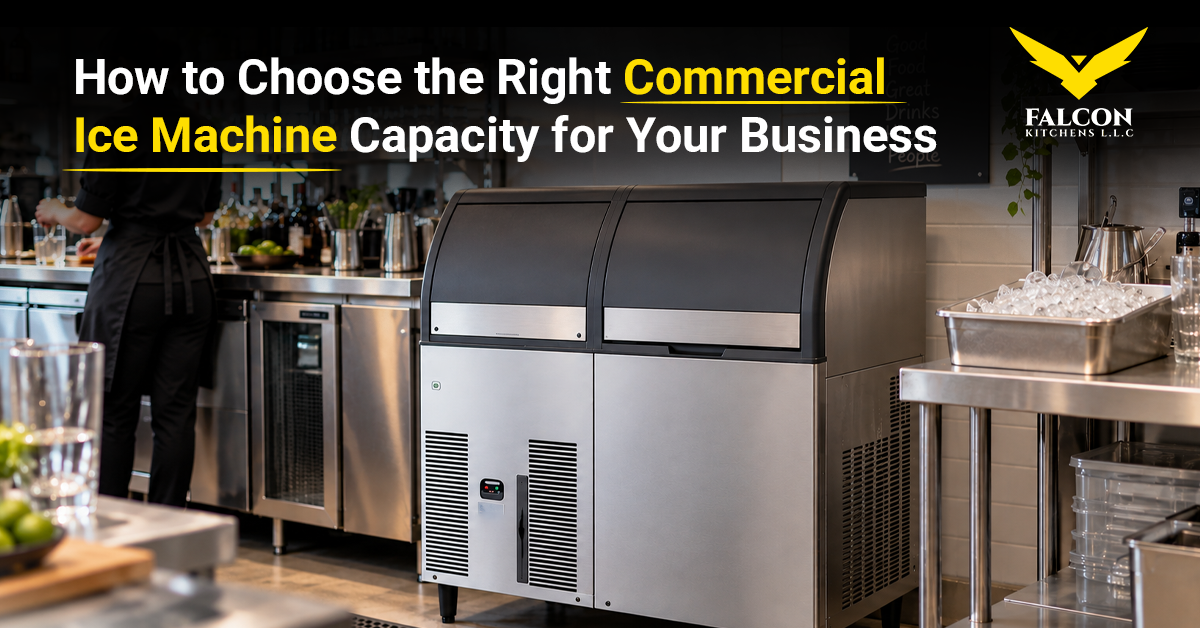
An undercounter commercial ice maker works well for smaller cafés, juice bars, and businesses with limited floor space.
These compact machines can fit beneath suitable counters and generally combine ice production with built-in storage.
They are practical when employees need quick access to ice during beverage preparation.
When Should You Choose an Industrial Ice Machine?
An industrial ice machine or high-capacity modular ice maker is more suitable for large restaurants, hotels, catering kitchens, and food-processing operations.
These machines can handle higher daily production requirements and are generally connected to separate storage bins.
Before installing one, check its ventilation space, electrical requirements, drainage, and water supply.
Which Ice Type Works Best for Restaurants and Hotels?
A commercial ice cube machine produces solid cubes commonly used in soft drinks, cocktails, and table-water service.
Other ice forms serve different purposes:
- Cube ice: Restaurants, hotels, and beverage counters
- Nugget ice: Soft drinks and selected specialty beverages
- Flake ice: Seafood displays and food presentation
- Crushed ice: Cocktails, smoothies, and chilled displays
Selecting the correct ice type is as important as choosing production capacity.
Why Does Ice Storage Capacity Matter as Much as Daily Production?
A machine rated to produce 150 kg of ice in 24 hours does not necessarily have a storage bin that holds 150 kg.
Production capacity measures how much ice the machine can make, while storage capacity determines how much ice remains available during busy periods.
For example, if a restaurant needs 45 kg of ice during its busiest two-hour period, its storage bin and production rate must support that demand.
Choosing an undersized bin can cause ice shortages even when daily production appears sufficient.
How Does Dubai’s Climate Affect Commercial Ice Machine Performance?
A commercial ice machine in Dubai may operate in kitchens where surrounding temperatures are higher than the conditions used for some advertised production ratings.
Warm incoming water, restricted airflow, and poorly ventilated installation areas can reduce production efficiency.
Before purchasing, check:
- Ice production ratings at higher ambient temperatures
- Manufacturer-recommended ventilation clearance
- Water filtration requirements
- Drainage arrangements
- Cleaning and maintenance accessibility
A well-ventilated location and regular maintenance can help keep the machine operating closer to its expected capacity.
What Should You Check When Comparing Commercial Ice Machine Prices in the UAE?
The commercial ice machine price in UAE varies depending on production capacity, brand, cooling system, ice type, and storage configuration.
Rather than choosing the lowest purchase price, compare the total operating cost.
Consider electricity consumption, water usage, replacement filters, maintenance expenses, warranty coverage, and spare-part availability.
A commercial ice maker that costs less initially may become more expensive if it consumes excessive energy or requires frequent repairs.
Before purchasing, request the manufacturer’s technical specifications and confirm whether installation and storage bins are included in the quoted price.
How Can You Select the Best Commercial Ice Machine for Long-Term Use?
The best commercial ice machine is one that meets your busiest day’s demand, produces the appropriate ice type, and fits your kitchen layout.
Avoid choosing equipment based only on the number of seats in your restaurant or the machine’s maximum advertised output.
Review actual ice consumption, storage requirements, local operating temperatures, and maintenance access before making a decision.
For restaurants, cafés, hotels, and catering businesses in the UAE, Falcon Kitchens can be considered when exploring commercial kitchen equipment and ice machine options. Comparing the machine’s technical specifications against your daily requirements will help you make a more practical purchase decision.
Frequently Asked Questions
1. What Size Commercial Ice Machine Do I Need for a Restaurant?
Calculate your busiest day’s ice consumption using approximately 0.7–0.9 kg per customer as a starting point. Add capacity for bar service, food preparation, and peak demand.
2. How Much Ice Can a Commercial Ice Maker Produce Per Day?
Production varies by model. Commercial ice makers may produce tens to hundreds of kilograms daily, while larger industrial systems can produce considerably more.
3. Which Commercial Ice Machine Is Best for a Café?
An undercounter commercial ice maker is often suitable for a small café. Choose its capacity based on daily iced beverage sales and peak-hour requirements.
4. Does a Commercial Ice Machine Use a Lot of Electricity?
Electricity consumption depends on the machine’s capacity, cooling design, operating conditions, and efficiency. Compare manufacturer energy ratings before purchasing.
5. What Is the Difference Between Ice Machine Production and Storage Capacity?
Production capacity measures the ice a machine can make in 24 hours. Storage capacity measures how much finished ice the bin can hold at one time.
